
What Is Thyroid Cancer?
Thyroid cancer is a malignancy arising from the thyroid gland, a butterfly-shaped organ located in the lower front of the neck. The thyroid plays a vital role in regulating metabolism, heart rate, body temperature, and energy levels. Importantly, thyroid cancer is among the most curable cancers, especially when detected early.
Thyroid Cancer – Key Statistics
Global Statistics
- Thyroid cancer accounts for about 3% of all cancers worldwide.
- Globally, there are approximately 5.8–6 lakh new cases every year.
- It is one of the fastest rising cancers in incidence, largely due to improved detection.
- Despite increasing incidence, mortality remains low, with a 5-year survival rate exceeding 90% overall.
India Statistics
- In India, thyroid cancer constitutes 1–2% of all cancers, but is one of the commonest endocrine cancers.
- Incidence is higher in women, with a female-to-male ratio of about 3:1.
- Most patients present in the third to fifth decades of life.
- When diagnosed early, cure rates in India are comparable to global outcomes.
Types of Thyroid Cancer
Thyroid cancer is not a single disease; it includes different types with varying behavior:
1. Papillary Thyroid Cancer
- Most common type (≈80–85%)
- Slow growing, excellent prognosis
- Often spreads to neck lymph nodes but remains highly curable
2. Follicular Thyroid Cancer
- Second most common
- Slightly more aggressive than papillary
- Can spread to lungs or bones
3. Medullary Thyroid Cancer
- Arises from C-cells of the thyroid
- May be sporadic or hereditary
- Requires specialized evaluation and family screening
4. Anaplastic Thyroid Cancer
- Rare but very aggressive
- Typically occurs in elderly patients
- Requires urgent, multimodality treatment
Why Thyroid Cancer Awareness Is Important
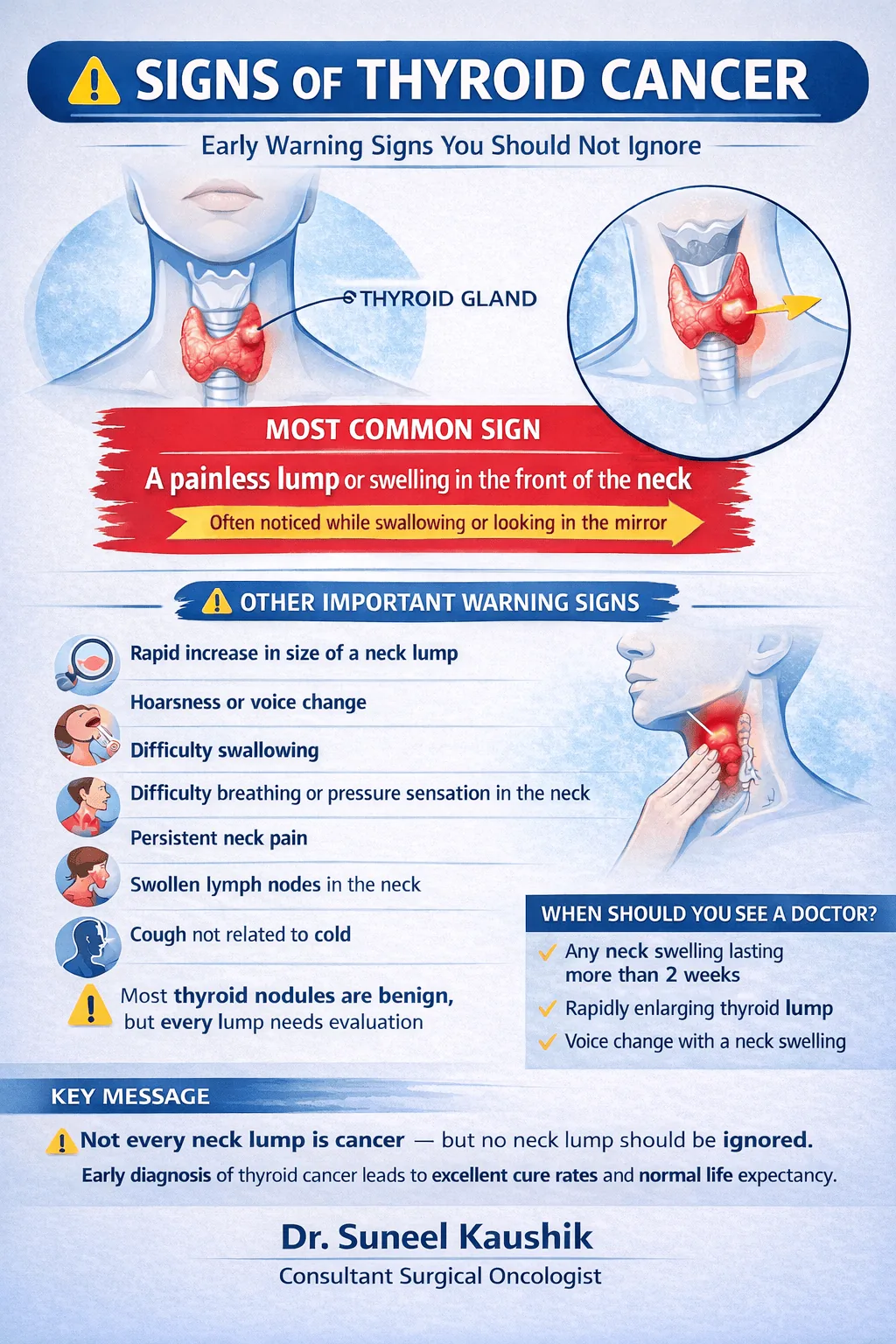
- Most thyroid cancers present as a painless neck lump, often ignored
- Many patients have no pain or systemic symptoms
- Early-stage disease has excellent cure rates (>90–95%)
- Delayed diagnosis may require more extensive surgery and treatment
Awareness ensures early consultation, simpler treatment, and better outcomes.
Who Is at Risk?
You may be at increased risk if you have:
- A thyroid nodule, especially if increasing in size
- Female gender
- History of radiation exposure to head or neck (especially in childhood)
- Family history of thyroid cancer or genetic syndromes
- Long-standing goitre or thyroid disease
- Extremes of age (very young or elderly patients)
Common Warning Signs
Seek medical evaluation if you notice:
- A lump or swelling in the front of the neck
- Rapid increase in size of a thyroid swelling
- Hoarseness or voice change
- Difficulty swallowing or breathing
- Neck pain or pressure sensation
- Enlarged lymph nodes in the neck
Most thyroid nodules are benign, but every thyroid lump must be evaluated.
How Is Thyroid Cancer Diagnosed?
Diagnosis involves a structured approach:
- Clinical examination of the neck
- Ultrasound of the thyroid to assess size and suspicious features
- Fine Needle Aspiration Cytology (FNAC) – key diagnostic test
- Blood tests (thyroid function, calcitonin in selected cases)
- CT / MRI scans when disease is advanced or invasive
Treatment Options (Detailed Overview)
1. Surgery (Mainstay of Treatment)
- Total thyroidectomy or hemithyroidectomy, depending on cancer type and stage
- Neck lymph node dissection if nodes are involved
- Surgery offers the highest chance of cure
2. Radioactive Iodine (RAI) Therapy
- Used in selected patients with differentiated thyroid cancers
- Helps destroy microscopic residual disease
- Improves long-term disease control in appropriate cases
3. Thyroid Hormone Therapy
- Lifelong thyroid hormone replacement after surgery
- Suppresses cancer-stimulating hormones and maintains normal metabolism
4. Targeted Therapy / Systemic Treatment
- For advanced, recurrent, or RAI-resistant disease
- Includes targeted drugs and newer therapies
5. Follow-Up and Surveillance
- Regular clinical examination
- Ultrasound and blood markers
- Long-term follow-up is essential for excellent outcomes
Key Take-Home Message
Not every neck lump is cancer — but no neck lump should be ignored. Early diagnosis of thyroid cancer leads to excellent cure rates and normal life expectancy.