
What Is Esophageal Cancer?
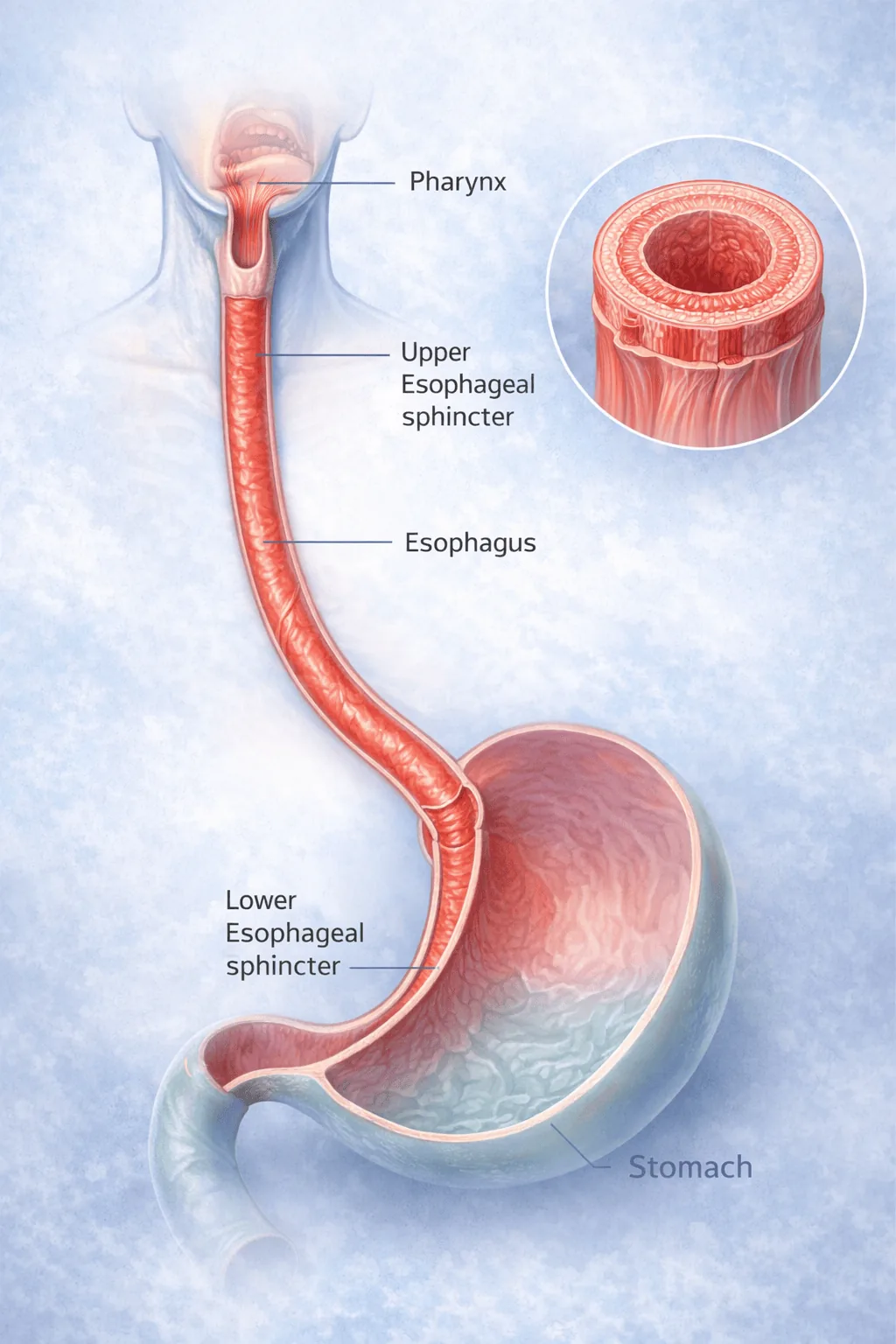
Esophageal cancer is a malignancy arising from the esophagus, the muscular tube that carries food from the mouth to the stomach. It is an aggressive cancer, but outcomes improve significantly when detected early, before severe swallowing difficulty develops.
Why Awareness Is Important
- Early symptoms are often ignored or mistaken for acidity
- Many patients present late, when swallowing becomes difficult
- Advanced disease requires complex treatment
- Early diagnosis improves survival and quality of life
Awareness helps people seek medical care before food obstruction occurs.
Esophageal Cancer – Key Statistics
Global
- Esophageal cancer is the 7th most common cancer worldwide
- Over 6 lakh new cases and 5.4 lakh deaths occur annually
- One of the leading causes of cancer-related mortality
India
- Among the top 10 cancers in men
- Higher incidence in certain regions due to tobacco, alcohol, and dietary habits
- Lack of awareness and delayed diagnosis, affecting outcomes
Types of Esophageal Cancer
1. Squamous Cell Carcinoma
- Most common type in India
- Arises from the upper and middle esophagus
- Strongly linked to smoking, alcohol, tobacco chewing
2. Adenocarcinoma
- Increasing in incidence
- Arises from the lower esophagus
- Associated with chronic acid reflux (GERD) and Barrett’s esophagus
Who Is at Risk?
You are at higher risk if you have:
- Tobacco use (smoking or chewing)
- Alcohol consumption
- Long-standing acid reflux (GERD)
- Difficulty swallowing for a long time
- Poor nutrition or very hot beverage consumption
- Previous head & neck cancers
- Age > 50 years (more common in men)
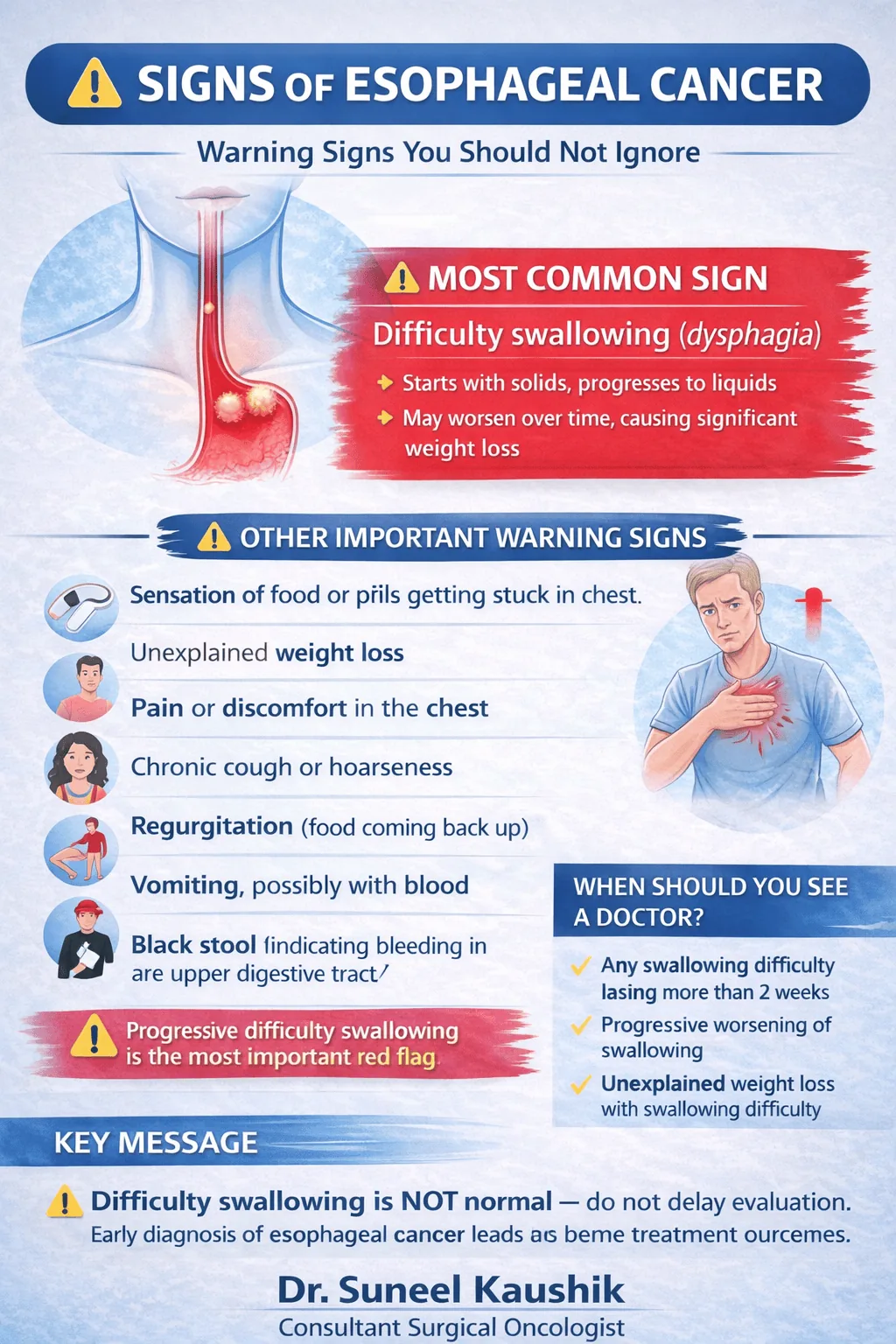
Common Warning Signs (Do Not Ignore)
Seek medical attention if you experience:
- Difficulty swallowing (dysphagia) – first solids, then liquids
- Sensation of food getting stuck in chest
- Unexplained weight loss
- Chest pain or burning sensation
- Persistent vomiting or regurgitation
- Hoarseness or chronic cough
- Blood in vomitus or black stools
Progressive difficulty swallowing is the most important red flag
How Is Esophageal Cancer Diagnosed?
Diagnosis involves:
- Upper GI endoscopy (direct visualization)
- Biopsy to confirm cancer
- CT scan / PET-CT for staging
- Endoscopic ultrasound in selected cases
- Nutritional assessment before treatment
Treatment of Esophageal Cancer
A Stage-Wise, Multimodality Approach
Management of esophageal cancer depends on the stage of disease, type of esophageal cancer, tumor location, and patient fitness. Best outcomes are achieved through a multidisciplinary team approach, involving surgical oncology, medical oncology, radiation oncology, gastroenterology, nutrition, and rehabilitation services.
1. Early-Stage Esophageal Cancer
(Stage 0–I)
Goal: Cure with organ preservation
Early cancers are often confined to the inner layers of the esophagus and may be detected incidentally during endoscopy.
Treatment Options:
- Endoscopic treatment (in very early lesions):
- Endoscopic mucosal resection (EMR)
- Endoscopic submucosal dissection (ESD)
- Surgery (Esophagectomy):
- Preferred for fit patients when deeper invasion is present
- Offers excellent long-term cure rates
Key Points:
- No chemotherapy or radiotherapy may be needed in selected cases
- Early diagnosis offers the best chance of complete cure
- Swallowing function is often well preserved
2. Locally Advanced Esophageal Cancer
(Stage II–III)
Goal: Cure through multimodality treatment
This is the most common stage at diagnosis. Cancer has spread deeper into the esophageal wall and/or to nearby lymph nodes.
Standard of Care: Multimodality Therapy
Neoadjuvant Chemoradiotherapy or Perioperative Chemotherapy (Before Surgery)
- Usually given before surgery to make treatment outcomes better
- Combination of chemotherapy and radiotherapy or chemotherapy alone depending on type of cancer
- Shrinks the tumor
- Improves chances of complete surgical removal
- Reduces recurrence risk
Surgery (Esophagectomy) – minimal invasive surgery preferred
- Performed after completion of chemoradiotherapy/chemotherapy
- Removal of the diseased esophagus and lymph nodes
- Reconstruction using stomach or colon
- Minimal invasive approach with laparoscopy or robotic surgery is preferred
Why Multimodality Treatment Matters:
- Improves survival compared to surgery alone
- Better local disease control
- Higher rates of complete tumor response
Multimodality treatment is now the global standard of care for locally advanced esophageal cancer.
3. Advanced or Metastatic Esophageal Cancer
(Stage IV)
Goal: Disease control, symptom relief, and quality of life
Cancer has spread to distant organs such as liver, lungs, or bones.
Treatment Options:
- Systemic chemotherapy
- Targeted therapy or immunotherapy (in selected patients)
- Radiotherapy for pain or bleeding control
- Endoscopic stenting to relieve swallowing difficulty
- Nutritional support (feeding tubes when needed)
Key Focus:
- Relief from dysphagia
- Maintaining nutrition and comfort
- Prolonging survival with good quality of life
Supportive Care – A Critical Component
Across all stages:
- Nutritional assessment and support
- Pain management
- Swallowing rehabilitation
- Psychological support for patients and families
Can Esophageal Cancer Be Prevented?
Risk can be reduced by:
- Avoiding tobacco and alcohol
- Treating acid reflux early
- Maintaining healthy diet and weight
- Seeking evaluation for persistent swallowing difficulty
When Should You See a Doctor?
- Difficulty swallowing lasting more than 2 weeks
- Progressive worsening of swallowing
- Weight loss with chest or swallowing symptoms
Consult an ENT specialist, Gastroenterologist, or Surgical Oncologist promptly.
Key Take-Home Message
Difficulty swallowing is NOT normal. Early evaluation of esophageal symptoms can lead to curative treatment and better survival.
Esophageal cancer treatment is not one-size-fits-all. Early stages may be cured with limited treatment, while locally advanced disease requires multimodality therapy for best outcomes. Advanced stages benefit from personalized, patient-centric care focused on comfort and dignity.